
 Open Access

News & Announcements
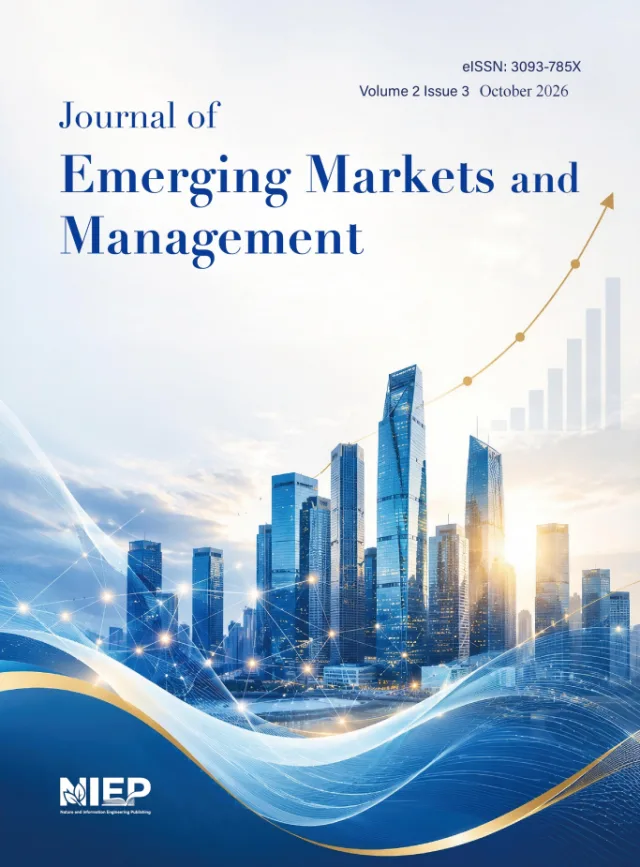
Journal of Emerging Markets and Management
2 November 2026

Emerging Markets and Management
Volume 02 | Issue 03 | October 2026
From "World Factory" to "Innovation Engine":
How Do Local Firms in Emerging Markets Stage Their Comeback?
— A Featured Reading Guide for This Issue
eISSN 3093-785X | Open Access | https://journals.niepublish.com/jemm
Editor's Note: One Reading Guide, One Fixing of the Journal's Coordinates
Within the editorial logic of Emerging Markets and Management (Journal of Emerging Markets and Management, JEMM), we have long been trying to answer three questions: what allows firms in emerging markets to break out of the old cycle of "contract manufacturing — low price — being defined by others"? Can management research stop borrowing theories developed in advanced markets and instead grow a genuine "Southern perspective"? How can an international journal focused on emerging markets be rooted both in scholarship and in industrial reality?
This issue we have selected the featured reading guide "From "World Factory" to "Innovation Engine": How Do Local Firms in Emerging Markets Stage Their Comeback" precisely because it strikes all three of these questions at once. JEMM's official positioning is very clear: it is a peer-reviewed, open-access journal dedicated to advancing research on business, finance and management in emerging markets, bridging academia and industry, and focused on economic development, corporate strategy and policy challenges, with a scope covering corporate governance, entrepreneurship, digital transformation, human resources, leadership, capital markets, FDI, fintech, trade and institutions, green and ESG, and other interdisciplinary frontiers. And this article does not frame "innovation" as a Silicon Valley narrative; instead it turns the lens back to the real settings of Africa, Southeast Asia, Latin America and China—mobile phones, mobile payments, super-apps, green transition, and supply-chain coordination. It braids the latent threads of "digital inclusion", "employment resilience" and "institutions and foreign investment" that run through the journal's already-published articles into a single, visible line.
We chose it not because it is "buzzing" but because it "stakes a position": it gives JEMM a cognitive anchor that few have systematically clarified—that innovation in emerging markets is not a marginal supplement to advanced markets but the main battleground of next-generation management knowledge.
1. Why This Issue Features This Article
The most direct answer is that it fits, to the last detail, what we are already doing.
Look first at the big trend. Data from the International Monetary Fund (IMF) show that emerging markets and developing economies have long contributed more than 60% of global economic growth, and the "engine" of the global economy is shifting south and east. Wherever the markets are, that is where innovation happens—when consumers numbering in the billions come online collectively, local firms instinctively understand the "shorthand" of these markets better than multinationals do. JEMM's editorial instinct is precisely to document how this cohort of firms that "know the locality better" are redefining the rules.
Then look at the actual lineup of our Vol. 2 No. 3 (October 2026): how digitalization in Kerala acts as an equalizer for self-employment and social inclusion; a scoping review of the adoption trends, drivers and barriers of digital commerce in Ghana; how the employment structure of Nigeria shapes its resilience against climate and market crises; and the relationship between foreign capital inflows and financial development in the MEDA region, with the moderating effects of governance and human capital. This set of articles looks scattered but in fact shares one main thread—how firms and societies make a "leapfrog" transition in institutionally weak, resource-constrained environments.
This issue's featured reading guide does nothing more than translate, for the reader, the thread hidden across those four articles into a sentence anyone can understand: local knowledge is itself a scarce source of competitive advantage. That is exactly why it deserves to headline this issue.
2. The Core Conclusion of the Article: The Underlying Logic of Local Innovation
Reading through the related studies in this issue, the conclusion can be compressed into a single sentence:
The comeback of emerging markets is, in essence, not "technological catch-up" but the reclamation of the "right to define scenarios"—using local knowledge to reconfigure cost, scenarios and ecosystems.
The article breaks local innovation into three "modes of unfolding", which together constitute exactly the "theoretical motif" for JEMM's future calls for papers.
2.1 Cost Innovation (Frugal Innovation)
Squeezing cost to the extreme without sacrificing core functionality. The portable electrocardiograph GE developed in India, priced at one-tenth of conventional equipment, is a textbook case. It shows us: the efficiency logic of emerging markets can in turn rewrite the "cost-leadership strategy".
2.2 Scenario Innovation (Leapfrog Innovation)
Having never laid fixed telephone lines, it went straight into the mobile-phone era. Kenya's M-Pesa lets people without a bank account make mobile payments, and Indonesia's Gojek packs ride-hailing, food delivery and payment into a single super-app. Infrastructure gaps are not a disadvantage but an "asymmetric opportunity"—cases like these are exactly the contextualized theoretical samples JEMM most needs to accumulate.
2.3 Ecosystem Innovation (Platform-Based Moats)
Building platforms and partner networks around a core business, linking logistics, payment and content one by one. It challenges the traditional strategic-management assumption of "focus on the core business"—in institutionally weak markets, "completing the ecosystem" is itself the core competency.
The article also confronts the bottlenecks head-on: talent and R&D, single channels of financing, and fragile intellectual-property and institutional ecosystems. Its judgment on this point is especially sharp—
"The bottleneck of innovation in emerging markets usually lies not inside the laboratory, but outside it."
3. The Value of Publishing This Article: Not a Press Release, but a "Cognitive Coordinate for the Journal"
For an international OA journal in its growth phase, a featured reading guide is not decoration but cognitive infrastructure. The value of this guide shows at four levels.
3.1 Theoretical Value: Turning "Emerging-Market Management" from an Adjective into a Subject
Much past research wrote of "doing strategy in emerging markets", with Western theory still as the subject. This article models another way of writing: the subject is "how emerging-market firms redefine innovation", perfectly in tune with JEMM's mission to "bridge academia and industry, reflect developing economies".
3.2 Methodological Value: Vindicating Review Articles and Short Communications
It blends macro data, corporate cases, literature reviews and a manager's toolkit. And JEMM's submission categories happen to include 6,000–10,000-word review articles and 1,500–3,000-word short communications—this reading guide is itself a demonstration: a rigorous yet unpretentious text can carry real problems just the same.
3.3 Reader Value: Speaking to Scholars, Managers and Policy Researchers at Once
Scholars: extract researchable constructs—local knowledge assets, leapfrog innovation, South-South collaboration.
Managers: obtain reusable tools—global brain-drain reversal plus local rootedness, digital leverage, pooled supply chains.
Policy researchers: see how institutions both hinder and uphold innovation.
3.4 Communication Value: Making the Journal "Seen"
The scholarly record is often buried in DOIs and abstracts. A reading guide with a story, a judgment and a Global South standpoint is the journal's vanguard in outward communication—it lets outsiders see at a glance what JEMM cares about, whom it represents, and which side it stands on.
4. Uniqueness, Innovativeness, Distinctiveness: A Differentiated Boost for JEMM
A young journal fears most of all "publishing everything, yet being nothing in particular". This guide happens to help JEMM establish its differentiation.
4.1 Uniqueness: Mutual Mirroring within the Global South, rather than "Western Theory + Eastern Examples"
The narrative of most international business journals is "using emerging-market data to validate mature models". This article reverses that: abstracting from cases in Kenya, Indonesia, Vietnam and China the idea that "local knowledge is the moat". This perspective remains scarce in English-language management journals, yet it is JEMM's native instinct.
4.2 Innovativeness: Academicizing the "Comeback"
"Comeback" is a media term; the article recasts it into analysable mechanisms: the dynamic capabilities of cost reconfiguration, scenario leapfrogging and ecosystem lock-in. This lets JEMM unambiguously accept manuscripts on "atypical innovation"—not showing off, not patent-worshipping, valuing institutional fit.
4.3 Distinctiveness: Building a "JEMM-Style Question List"
It indirectly leaves the journal a unique pool of questions; whoever can systematically answer them in the future will define "emerging-market management".
5. Concrete Support for the Journal's Development: From "Good Articles" to "Good Mechanisms"
The real value of a reading guide lies not in how elegantly it is written, but in whether it can settle into a mechanism for the journal's long-term operation. Centered on JEMM's current editorial reality—open access, a quarterly rhythm, three article types (original / review / short communication), the CC BY 4.0 licence, double-blind review and the COPE ethical guidelines—this featured reading guide can be converted, across five dimensions, into concrete, actionable and assessable support.
5.1 Establishing a Section: Using This Article as an Opening, Set Up a Standing Column "Southern Innovation"
JEMM's current scope already covers entrepreneurship, digital transformation and corporate governance, but it lacks a flagship column that can string them together. We propose using this issue's guide as an opening and establishing a standing "Southern Innovation" column, with at least one related manuscript in every issue. There are three benefits: first, it gives authors a clear "destination for submissions", reducing topic drift; second, it gives the journal a highly recognizable calling card in search and dissemination; third, it plants the seeds for a future collected special issue. Once the column is established, this issue's guide ceases to be a one-off promotional piece and becomes a foundational text of the column.
5.2 Strengthening Recognition: Embedding a Preference for "Contextual Mechanisms" in the Review Criteria, Forming a "Scenario-School" Reviewing DNA
JEMM operates double-blind peer review, and the objectivity and rigor of review are the baseline. We can add a "contextual contribution" dimension to the review form: does the study reveal institutions, cultures or infrastructure mechanisms particular to emerging markets, rather than merely using emerging-market data as a sample to reproduce mature models? This clause does not change the review criteria; it gives the criteria a sense of direction. In the long run it will give the journal's published articles a consistent "scenario-school" character—the moment readers see JEMM they know its articles speak to "why things work differently here". This is precisely the scarcest asset for a new journal: recognizability.
5.3 Expanding the Author Pool: Using an Approachable Narrative to Attract Young Global South Scholars to Write "Their Own Stories" into Standard Papers
JEMM's author section explicitly welcomes three kinds of manuscript—original research (5,000–10,000 words), reviews (6,000–10,000 words) and short communications (1,500–3,000 words). For young scholars in Africa, Southeast Asia and Latin America, the tone of this article is an invitation: you need not write your paper as a copy of a Western journal; you may write head-on about local phenomena such as M-Pesa, Gojek or Transsion, provided the method is rigorous. At the same time, the short-communication category provides an outlet for preliminary findings, innovative methods and cases worth recording that are "insightful but not yet a full paper". This is the most economical and most dignified way to expand the author pool—not lowering standards, but lowering the threshold of the expressive posture.
5.4 Increasing Citations and Reach: Letting the Guide Feed Back into the Main Journal, Forming a "Guide—Original Article—Resubmission" Loop
This is the most quantifiable form of support. Phrases mentioned in this article such as "digitalization as a socio-economic equalizer", "a scoping review of digital-commerce adoption", "employment resilience" and "foreign capital inflows and the governance climate" can be linked directly to the four original articles in our Vol. 2 No. 3. We propose adding a DOI hyperlink on the guide's page for each article mentioned, and a back-link to this guide on each main-journal article page. Because the journal uses the CC BY 4.0 licence and authors retain copyright, the re-circulation and reprinting of the guide face almost no licensing barriers and cost almost nothing. Its effect is a trackable conversion chain: readers drawn by the guide → download the original articles → cite the original articles → authors see the journal's style → submit new manuscripts.
5.5 Building a Brand Personality: Making JEMM "the Journal That Files Overlooked Management Wisdom"
The meaning of open access is not merely free reading but letting the voices overlooked by the mainstream system enter the record of knowledge. JEMM upholds the COPE principles of transparency and best practice and encourages data sharing and reproducibility. Translating this ethical foundation into a sentence readers can remember, it is: "We file the management wisdom that has been overlooked." This issue's guide happens to play exactly this role of translator—it turns abstract policies and principles into a warm, committed brand personality. And brand personality is the journal's last line of defense in outlasting cycles and resisting homogenization.
For ease of execution, the actions, channels and measurable indicators corresponding to the five forms of support above are summarized below:
|
Direction of Support |
Action to Implement |
Supporting Mechanism / Column |
Measurable Indicator |
|
Establish a Section |
Set up a standing "Southern Innovation" column |
At least 1 related manuscript per issue |
Share of column articles, number of special issues |
|
Strengthen Recognition |
Add a "contextual contribution" dimension to the review form |
Double-blind peer review |
Mean contextual-item score in reviewer comments |
|
Expand the Author Pool |
Invite young Global South scholars with an approachable narrative |
Three types: original / review / short communication |
Share of emerging-market authors, number of short-communication submissions |
|
Increase Citations |
Hyperlink original articles on the guide page; back-link the guide on article pages |
CC BY 4.0 open dissemination |
Original-article downloads, citation count |
|
Build the Brand |
Standardize the "filing overlooked wisdom" messaging |
COPE ethics and data sharing |
Social-media reach, website return-visit rate |
6. Highlights Refined Again: "Signature Lines" for JEMM
We propose adopting the following lines as fixed messaging assets for the journal's outward communication, to be used repeatedly and accumulated over the long term:
"Innovation belongs not only to Silicon Valley, but to every emerging-market firm that observes its users with care."
"Local knowledge is a scarce asset that multinationals cannot buy and cannot copy."
"From world factory to innovation engine, what changes is not the label but the right to define."
"Beyond the laboratory lies the true scene of innovation in emerging markets."
7. Conclusion
JEMM is in its growth phase. At the Volume 2 stage, what it most needs is not volume for its own sake but a striking act of self-definition.
This reading guide, "From 'World Factory' to 'Innovation Engine'", ostensibly writes of a corporate comeback, but at its root writes of a journal's ambition: chasing real problems rather than trendy buzzwords; treating emerging markets not as a sample library but as a source of knowledge; not letting management theorize at firms, but letting firms re-teach management.
It tells readers: JEMM's editorial standard is not "does it look like an international journal", but "does it perceive the business wisdom of another world".
Born of the locality, grown toward the global.
The great drama of this journal has only just begun.
About This Journal
Journal of Emerging Markets and Management (JEMM, Emerging Markets and Management) is a peer-reviewed, open-access international English-language academic journal published by Nature and Information Engineering Publishing in Malaysia, with the international standard serial number eISSN 3093-785X. The editor-in-chief is Professor Iskandar Muda of Universitas Sumatera Utara, Indonesia. The 2026 publication schedule is quarterly, appearing regularly in March, June, September and December; this issue is Volume 02 Issue 03 (October 2026).
Editorial mission: dedicated to advancing research on business, finance and management in emerging markets, bridging academia and industry, and focused on the transformation of emerging economies and innovation in enterprise management. The scope covers interdisciplinary frontiers such as corporate governance, entrepreneurship, digital transformation, human resources and leadership, capital markets and FDI, fintech, trade and institutions, green and ESG, and marketing and consumer behaviour.
Submission categories: original research articles (5,000–10,000 words), review articles (6,000–10,000 words) and short communications (1,500–3,000 words). Double-blind peer review is conducted in accordance with the COPE publication ethics guidelines; accepted articles are published under a Creative Commons Attribution 4.0 International (CC BY 4.0) licence, with authors retaining copyright.
Journal website: https://journals.niepublish.com/jemm
Submission system: https://journals.niepublish.com/jemm/about/submissions
Editorial office email: jemm@niepublish.com
© 2026 Nature and Information Engineering Publishing. All rights reserved.