
 Open Access

News & Announcements
AI Translation Is Fast and Cheap—So Why Has It Still Not Taken Translators' Livelihoods?
30 October 2026

— A Curated Reading Guide to This Issue and an Explanation of the Journal's Publishing Value
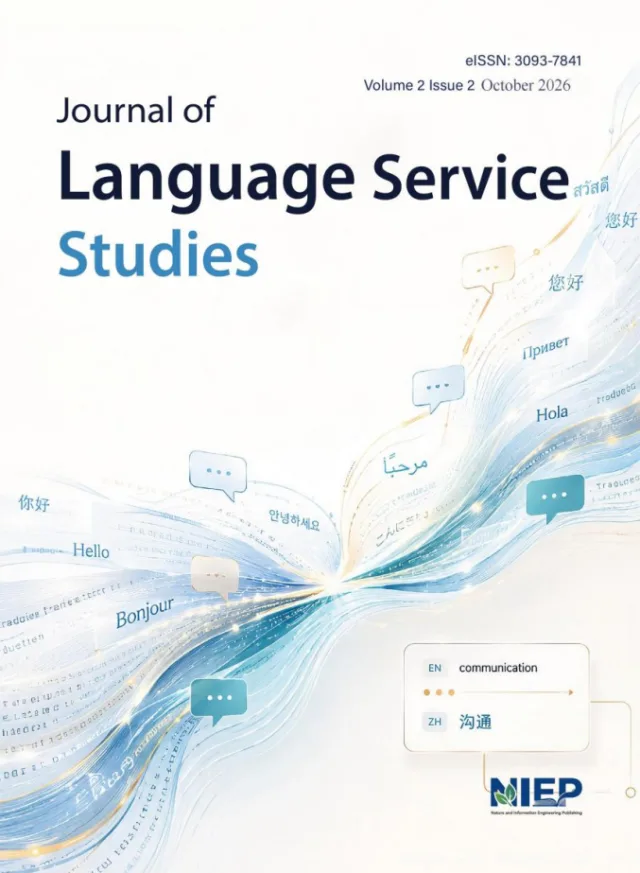
eISSN 3093-7841 (Open Access)
Volume 02 | Issue 02 | October 2026
Editor-in-Chief: Prof. Wang Lifei (Beijing Language and Culture University)
Published by: Nature and Information Engineering Publishing (NIEP, Nature and Information Engineering Publishing)
Focused on the Language Service Industry · Translation · Interpreting · Localization · Language Technology · Talent Development
Introduction
At two in the morning, a technical contract dozens of pages long is fed into a large model, and a translation is produced in seconds; at an exhibition and convention center, AI simultaneous-interpretation equipment renders a speaker's words into seven or eight languages in real time. The progress of machine translation has been dazzlingly fast. Yet behind all the excitement, an unvarnished truth has quietly surfaced across the industry: fast and cheap is still far from accurate and deliverable.
Are translators' livelihoods still secure after all? Will interpreters be replaced by machines? Where will language technology take the language services industry? This issue of JLSS curates several papers focused on "translation and interpreting, language technology, and human-machine collaboration in the age of machine translation." The aim is not to join an emotional "human-versus-machine" showdown but to lay out the full picture of the contest: at a moment when generative AI is reshaping the way the world communicates, what kind of scholarly home does language services—a knowledge-intensive, technology-intensive, and scenario-complex industry—truly need?
I. Why This Issue of JLSS Selected This Set of Articles
JLSS's editorial positioning is crystal clear: it is a professional academic journal focused on the field of language services, concentrating on translation and innovation in the language industry in the digital era and spanning such interdisciplinary frontiers as translation studies, localization services, AI translation technology, governance of the language industry, language policy, multilingual communication, terminology standardization, and cross-cultural communication.
In the past, research on language services long "lodged" on the margins of several disciplines:
Translation studies:translation studies dwell on "fidelity and aesthetics" and say little about delivery pipelines;
Linguistics:linguistics dwell on "corpora and models" and say little about industry risks;
Management:management scholarship studies the service industry yet often lacks a grasp of terminology consistency.
This issue's selected set of articles falls precisely where JLSS most needs to fill the gap—it lays out an entire language-services value chain:
The technology layer: the capability boundaries of neural machine translation and its typical failure cases;
The process layer: how MTPE (machine translation plus post-editing) is becoming a core competency of the new profession;
The scenario layer: the redivision of labor brought by AI simultaneous interpretation in exhibitions, business talks, and negotiations;
The talent layer: the path of transition from "translation craftsman" to "language services engineer";
The governance layer: language data security, ethical compliance, and cross-border auditing.
This is not "riding the AI hype" but the core proposition JLSS fixed at its very founding—language services are not "an extension of translation" but an independent discipline and industrial ecosystem.
II. The Academic and Industry Value of the Articles Themselves: Turning "Gut Feel" into "Methodology"
1. Neither deifying the machine nor shielding what lags behind
The original article notes that the quality of machine translation in general domains has improved markedly over the past five years, yet terminology clashes in long documents, misaligned legal clauses, and cultural puns gone wrong remain the norm. What JLSS values in such research is not the conclusion that "machine translation is imperfect," but that it structures the "imperfection":
which kinds of texts can be machine-translated;
which kinds of texts must be safeguarded by human effort;
which errors are fatal and which are merely matters of polish.
This offers the industry a framework for risk grading and echoes the journal's mission of "solving real-world problems in the industry."
2. Recasting MTPE from a "stopgap" into a "new paradigm"
Ten hours of pure human labor; pure machine translation that cannot be delivered; light post-editing that yields an acceptable deliverable in three hours—behind this set of figures lies a change in the relations of production. By selecting such research, JLSS is advancing a disciplinary consensus: the core competence of future language-services talent is not "translating from scratch" but "judging—orchestrating—polishing—being accountable."
3. The "human-machine redivision of labor" in interpreting scenarios
AI simultaneous interpretation suits high-volume, multilingual, syntactically regular settings; human interpreters retreat to the positions of on-the-spot judgment, cultural improvisation, emotional calibration, and negotiation mediation. This is a direct reinforcement of the journal's "language-services scenarios and ecosystem" track: it pulls interpreting back from "anxiety over replacement" toward "role reconstruction."
4. Talent transition: the language services engineer
Terminology databases, engine parameters, quality assessment, project management, data annotation—these competencies are brought into relief in the original article. JLSS has always stressed composite "language + technology + industry" research, and this article perfectly illustrates what the discipline must cultivate: not a pricier "pen," but a better systems-literate "language systems designer."
5. Data ethics: the bottom-line issue that gets overlooked
Confidential contracts flowing into public large models; cross-border corpora retained for training—the original article sounds an alarm for the industry. This strikes directly at the center of JLSS's "language industry governance" target: beyond technical efficiency, there must be scholarly discussion of data classification, environmental isolation, and auditable traceability.
III. Boosting the Journal's Development: From "Publishing" to "Defining a Field"
1. Uniqueness: holding fast to a discourse domain exclusive to "language services"
JLSS takes language services as an independent object of study, not an appendage of translation studies. This issue's articles put AI translation, localization, interpreting, and data security into a single discussion under the "full language-services chain," reinforcing a clear signal: talking about AI translation should not be confined to computer-science conferences, nor should talking about translators' future be confined to the literary-translation circle—JLSS is the best-fit venue for these debates.
2. Innovation: defining new common sense through a "cross-disciplinary lens"
The article blends perspectives from multiple disciplines:
Technology:computational linguistics (NMT evaluation)
Communication:communication and interpreting studies (simultaneous-interpretation settings)
Talent:labor and career studies (career transition)
Governance:information security (data governance)
This interdisciplinarity is not a piling-up of labels but the research paradigm the journal champions: "language × technology × business × society." It sets JLSS apart from traditional foreign-language journals: we do not merely explain language, but explain how language is delivered, priced, and risk-controlled.
3. Industry feeding back into scholarship: building a two-way channel between "academia" and "industry"
The original article includes cost calculations, field records from an exhibition, and tracking of translators' career transitions. This fits JLSS's open-access orientation and its emphasis on practical case studies: companies can see the research methods, scholars can obtain real pain points, and students learn what the market wants. The journal thus turns from a "repository of papers" into "industry infrastructure."
4. Institution-building for the discipline: giving "language services studies" a skeleton
Without a journal, there is no discipline. This issue implicitly completes a whole conceptual scaffold: the capability boundaries of machine translation → human-machine collaboration workflows → the division of labor across scenarios → a talent model → governance rules. Future citers will write reviews, build courses, and set standards along this line—and the anchor point of origin lies in JLSS.
5. International reach and the attraction of younger readers
AI translation is a topic across the whole of society. Selecting articles in a "soft reading guide + hard scholarship" manner can attract:
junior faculty at universities (in search of research topics);
master's and doctoral students (writing literature reviews);
language-technology entrepreneurs (in search of evidence);
corporate localization leads (in search of frameworks).
For a new journal this is critically important: only after being "read" can one be "cited."
IV. The Brand Highlights This Curated Reading Guide Adds to JLSS
We condense the value of this reading guide into four keywords:
|
Keyword |
Substance |
Significance for the Journal |
|
Exclusivity |
A journal dedicated to language services, neither borrowing another shell nor diluting itself; AI translation must be discussed within the context of "service delivery." |
Establishes the field's first landing point, occupying a place in the minds of authors and readers alike. |
|
Foresight |
Rather than summarizing only after the industry has settled, it builds evaluative frameworks mid-transition: what constitutes good human-machine collaboration. |
Enhances its power to lead research topics, attracting cutting-edge submissions. |
|
Practicality |
Instead of empty talk about "AI empowerment," it calculates costs, differentiates scenarios, lists risks, and maps out career paths. |
Strengthens the industry-academia-research loop, expanding subscriptions and citations from the industry. |
|
Governance |
It pursues efficiency without abandoning the bottom line, writing data ethics into the mainline of language services. |
Distinguishes it from purely technical journals, shaping a responsible academic brand. |
V. Conclusion: By Selecting This Article, JLSS Is Answering a Question
Machine translation has not wiped out the translation industry; it has forced it to evolve. Likewise, by selecting this set of articles, JLSS is not seeking to "reassure translators" but is answering a question:
When language can be generated by models, on what grounds can language services exist as an independent discipline?
The answer lies in five layers: the accuracy of terminology, the judgment of scenarios, the nuance of culture, the command of process, and the bottom line of data. These are things the machine cannot yet provide—but this journal can study them, regulate them, and disseminate them.
The future of language services is not "humans replaced by machines" but rather—machines run speed and scale, while JLSS records and shapes human judgment.
This is the value of this issue's curated reading guide, and the very reason this journal exists.
References
[1] ISO. (2017). ISO 18587:2017 Translation Services — Post-Editing of Machine Translation Output.
[2] Slator. (2025). Slator AI Translation and MTPE Report.
[3] International Association of Conference Interpreters (AIIC). (2024). AI and Conference Interpreting: A Position Paper on Human-Machine Collaboration.
[4] Common Sense Advisory. (2025). Machine Translation Post-Editing Benchmarks.
[5] Translators Association of China. (2025). Ethical Guidelines for Machine Translation and Language Services.
Journal Information
Journal of Language Service Studies
ISSN:eISSN 3093-7841 (Open Access)
Publisher:Nature and Information Engineering Publishing (NIEP, Nature and Information Engineering Publishing)
Editor-in-Chief:Prof. Wang Lifei (Beijing Language and Culture University)
Publication Frequency:Biannual (semiannual) for both 2025 and 2026, published regularly in April and October
Indexing:Google Scholar, Crossref, J-Gate, Europub, OpenAlex, among others
Mission:Cultivating scholarship, empowering industry, connecting the world, and innovating while upholding integrity
Journal Website:https://journals.niepublish.com/jlss
Editorial Team:https://journals.niepublish.com/jlss/about/editorialTeam
Journal Email: jlss@niepublish.com
Note:This curated reading guide corresponds to the human-machine collaboration theme of Vol.2 No.2 (October 2026); article content is subject to the papers formally published in the corresponding issue. Language services researchers, technology developers, and industry practitioners are welcome to submit and reprint (CC BY 4.0).