
 Open Access
News & Announcements
The Half-Sentence That Machine Translation Cannot Take Away: Why the Journal of Language Service Studies Selected This "Human–Machine Symbiosis" Paper
9 May 2025

Featured Reading Guide · Editor's Note
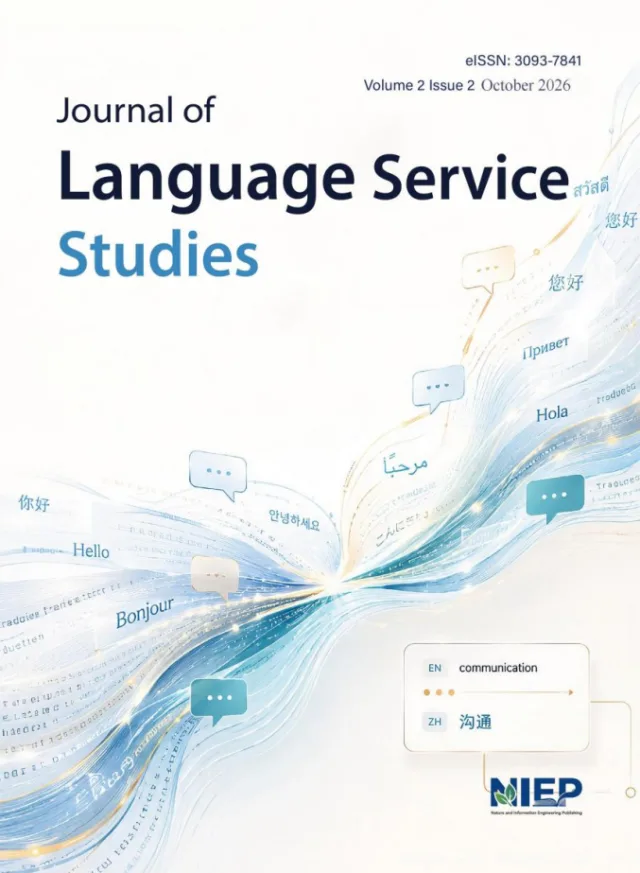
Journal of Language Service Studies (JLSS) 《语言服务研究杂志》
eISSN 3093-7841 | Volume 02 | Issue 01 | April 2026
I. What This Paper Is Answering: Not "Will AI Replace Translators," but "Which Half-Sentence Do Humans Keep for Themselves"
Take a photo of a menu and English appears; at a conference, AI simultaneous interpretation produces a draft in minutes—the pulse beating in the minds of language service practitioners is faster than the clacking of keyboards. The featured paper in this issue, "Reconceptualising Language Services in the Age of Artificial Intelligence" (Olusegun Oladele Jegede, Vol. 2 No. 1), does not side with either the "replacement thesis" or the "sentiment thesis." Instead, it uses socio-technical systems theory to re-anchor the question:
In one sentence: technology solves "speed"; humans solve "aptness."
Machine translation is impressively efficient in boilerplate clauses, technical manuals, and large-scale localization; yet the moment it touches idioms, puns, emotion, and cultural nuance, it exposes a gap of "word-for-word but not meaning-for-meaning." The author compresses the irreplaceability of human translators into three cornerstones—linguistic intuition, cultural competence, and ethical responsibility—and offers a "collaboration model": AI produces the first draft, builds the terminology database, and consumes structured text; humans take over for post-editing, cultural review, and final accountability.
The paper lands on a restrained yet weighty conclusion: the future of language services is not an either-or choice between "human vs. machine," but humans working alongside machines to make cross-cultural communication more dignified.
II. Why JLSS Selected It: This Journal "Was Meant to Take on This Question"
JLSS's founding statement is quite plain: it is "the first professional academic journal at home and abroad dedicated to the field of language services," with the mission of "deep scholarship, industry empowerment, global integration, integrity and innovation," covering translation and language services education, intelligent translation, business/legal/medical/emergency/age-friendly language services, language service space, and language technology.
Look again at where the paper lands, and it matches the journal's scope of submissions almost item by item:
• Intelligent translation × human–machine workflow: corresponds to Intelligent Translation and Language Services.
• Post-editing and ethical guidelines: corresponds to Language Service Technologies and industry norms.
• Curriculum reform and digital literacy: corresponds to Translation and Language Service Education.
• Cultural nuance and accountability mechanisms: corresponds to cross-cultural communication and language industry governance.
It is unlike traditional translation journals that discuss only texts, and unlike purely technical journals that discuss only models; it sits precisely on JLSS's "language–technology–society–business" intersection. Selecting this paper is not chasing a trend, but crystallizing the journal's positioning into a readable, teachable, shareable specimen.
III. The Value of Selection: A Threefold Significance for Readers, Authors, and the Discipline
1. For Readers: Translating "Anxiety" into Actionable Judgment
Translators, localization engineers, translation students, and corporate language asset managers often have only two vague feelings about AI: "fear of being replaced" and "fear of quality failure." This paper gives them a set of criteria: which texts can be safely machine-translated (structured, low-risk), which must go through human final review (culturally loaded, emotional, legally liable), and what the labeling obligation and accountability boundary of "AI-assisted generation" are. The theory and judgment are not detached; they turn directly into a division of labor on the workbench.
2. For Authors: Giving "Cross-Disciplinary Language Services Research" a Venue That Confirms Its Name
People who work on AI translation find computer science journals too "language-studies-heavy," and translation journals too "tech-heavy." JLSS sits in exactly the right place: it models "human + machine + institutions" together with a socio-technical systems framework, connecting both the practical feel of computational linguistics and the cultural depth of translation studies. This paper proves that discussing prompts, terminology databases, and post-editing workflows can also be serious scholarship.
3. For the Discipline: Lifting "Language Services" from an Ancillary Craft to an Object of Governance
In the past, language services were often seen as "translation outsourcing." This paper pulls the lens back to the level of curricula, industry standards, and institutional frameworks—how professional standards should be defined in the AI era, how talent should be cultivated, and who is accountable for mistranslation. This is precisely how language services are advanced to the level of "industry governance + technology ethics," echoing JLSS's scope for submissions on language industry governance, language policy, and terminology standardization.
IV. Contribution to the Journal's Development: Distinctiveness, Innovation, and Identity
1. Distinctiveness: First-Dedicated-Journal Positioning × Real Industry Pain Points
There are many general linguistics journals and quite a few translation journals, but JLSS is the first international journal to take "language services" as its disciplinary object. This paper magnifies that distinctiveness to the outside world: it speaks not only of "whether the translation is accurate" but of "how the industry fields a team"; not only of "whether the model is powerful" but of "how humans command the model"; and it seeks problems not only in the study, but in menus, contracts, meetings, and classrooms. Readers can recognize at a glance: this is a JLSS piece—a technology question that never loses its human warmth.
2. Innovation: Old Framework, New Flesh, Giving "Human–Machine Symbiosis" Its Coordinates
The innovation does not lie in coining new buzzwords, but in three concrete points:
• Framework migration: transplanting socio-technical systems theory from the context of industrial management into AI translation workflows, proposing a dual-wheel model of "social subsystem (human/institutions/ethics) + technical subsystem (MT/LLM/terminology database)."
• Role redefinition: the translator is not a "proofreader" but a "technology commander"—one hand on the machine-translated first draft, the other on cultural gatekeeping.
• Education pushback: making AI literacy, post-editing, and ethics training a requirement of curriculum reform rather than an elective motivational talk.
This provides a paradigmatic template for JLSS's future standing special features such as "digital-and-intelligent language services education" and "AI translation governance."
3. Identity: Cross-Cultural Editorial Board × Global South Perspective × Industry Frontline
JLSS's editorial board spans universities in China, the United States, the West, Australia, and Hong Kong and Macao, and Editor-in-Chief Professor Wang Lifei has long advanced the disciplinization of language services and the construction of national standards. Although this paper comes from an international author, the "cultural nuance," "accountability mechanism," and "localization ethics" it discusses naturally connect to the multilingual localization of Chinese companies going global, emergency communication in Belt and Road minor languages, and technological equity for low-resource languages in the Global South.
It helps the journal settle into a signature that no one else can copy: a realist school of "human-centered language-technology intersection." In the future, when academia asks "how to position humans in language services in the AI era," it will cite this issue.
V. What Is the "Strategic Move" of This Issue's Selection
It is not a hastily assembled hot topic, but a deliberate move to build a section:
• Establish a label: JLSS = the language services journal that dares to put AI translation back on the industry frontline.
• Cultivate an author community: attracting sustained submissions from young scholars in post-editing, localization project management, language technology, and language policy.
• Expand readership: scholars look at frameworks, practitioners look at workflows, teachers pull case studies, and public-account posts travel well.
• Strengthen dissemination: Open Access + CC BY 4.0, with quotable and translatable golden lines and model diagrams.
• Connect to industry standards: echoing discussions of national language services standards, terminology standardization, and professional ethics of AI-assisted translation.
VI. Highlights Re-Extracted (Ready for the Website Abstract Card)
|
Dimension |
Highlight |
|
Theoretical anchor |
Socio-technical systems × human–machine collaboration model |
|
Real-world entry point |
From "menu photo translation" to industry accountability |
|
Journal alignment |
Language + technology + education + industry governance, all hit |
|
Disciplinary thrust |
Lifting language services from an "ancillary craft" to an "object of governance" |
|
Cumulativeness |
Can extend into a standing "AI and Language Services" special feature |
VII. Conclusion: Fast Is the Machine; Nuance Is What Humans Leave Behind
From hand-written translations, to CAT tools, to large-model simultaneous interpretation, what changes is the tool; what does not change is the question:
Which words must have someone accountable for them, and which nuance can only be reserved by humans.
JLSS's selection of this paper is neither an endorsement of AI nor nostalgia for human labor, but a way for the journal to say its mission out loud: language services research must return to the industry frontline and, for communication sped up by algorithms, preserve a measure of cultural judgment and human responsibility.
Next time AI translates a whole contract in one pass, if the translator can ask one more question—"does this machine know when a pleasantry might offend?"—then this issue's paper will have done its job.
The Editorial Office of the Journal of Language Service Studies
April 2026 · Volume 2, Issue 1