
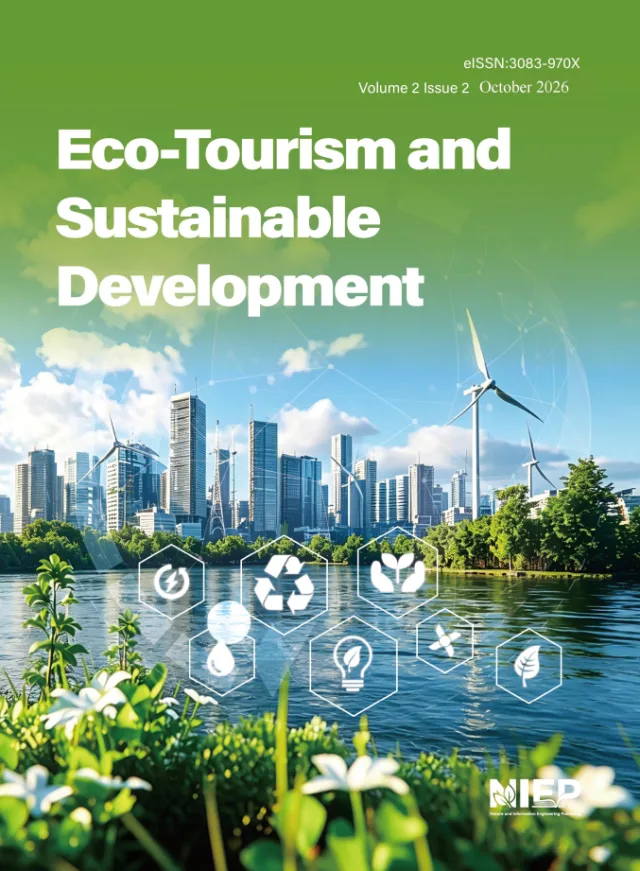

Volume 2 Issue 2 cover

Open Access · 2026

Volume 2 Issue 2


Eco-Tourism and Sustainable Development

Browse all issues →

Issue Highlights

Tourism resilience is shaped not only by destination appeal but also by the capacity to manage environmental constraints, economic interdependence, and social disruption. This issue examines how strategic communication and digital memory can support destination recovery in Ukraine, while research from Morocco addresses water governance in water-stressed tourism regions. Further contributions explore tourism–agriculture linkages in Kenya, digital infrastructure in Cameroon, slow-tourism preferences, and camping destination planning in the Philippines. Studies of ecotourism risks and eco-volunteerism in Nigeria add a community and management perspective, highlighting the need for adaptive, inclusive, and resource-conscious tourism development.

Table of Contents

12 articles

Impacts of Socioeconomic Characteristics and Landscape Elements on Users’ Preferences in Nigerian Tourist Centres

Olusola Makinde, Olubukunmi Makinde, Isidore Ezeme, Olabode Oludayo Akangbe

Eco-Tourism and Sustainable Development · 1–18 · 10.63385/etsd.v2i2.510

There is a notable gap in empirical research focusing on the impacts of socioeconomic characteristics and quality of landscape elements (LEs) on users' preferences and experiences, particularly in Nigerian tourist centres. Six tourist hotels were carefully chosen, one from each state in South-West Nigeria. Accidental sampling me

Read article →↓ PDF Cite720 views711 downloads

Reframing Sustainable Tourism in Crisis-Affected Destinations: Strategic Communication, Digital Memory, and Destination Recovery in Ukraine

Liudmyla Bovsh, Alla Rasulova, Larysa Hopkalo

Eco-Tourism and Sustainable Development · 19–49 · 10.63385/etsd.v2i2.101056

Global environmental crises, armed conflicts, and large-scale infrastructure disruptions increasingly challenge the foundations of sustainable tourism, particularly in destinations experiencing prolonged instability and environmental loss. This study examines how sustainable tourism can be reconfigured in crisis-affected destina

Read article →↓ PDF Cite878 views557 downloads

Driving Factors of Czech Consumers in the Context of Slow Tourism

Lenka Švajdová

Eco-Tourism and Sustainable Development · 50–61 · 10.63385/etsd.v2i2.101071

The intensifying discussion of a slower pace of life has increased interest in the concept of slow tourism. This value-driven approach contrasts with faster, mass travel and is consistent with sustainable economic, social and environmental development. This study empirically identifies the factors shaping Czech consumers’ attitu

Read article →↓ PDF Cite572 views372 downloads

Influence of Landscape Maintenance on Users’ Experiences in Tourist Centres

Olusola Oladapo Makinde, Olubukunmi Temitope Makinde, Isidore Chukwunweike Ezema, Olabode Oludayo Akangbe

Eco-Tourism and Sustainable Development · 62–83 · 10.63385/etsd.v2i2.101064

The diligent upkeep of landscapes in tourist centres is crucial not only for aesthetic reasons but also for fostering a sense of safety and security, ensuring a positive experience for visitors and preventing the degradation of the park environment. This study evaluates the influence of landscape maintenance on user experiences

Read article →↓ PDF Cite559 views403 downloads

The Impact of Green Perceived Risk on Hotel Visit Intention: The Mediating Roles of Green Trust and Environmental Motivation

Sukrisno, Pranoto, Haniek Listyorini, Idah Kusuma Dewi, Gana Wuntu, Septa Intiar, Sapto Supriyanto, Umar Abdul Jabbar

Eco-Tourism and Sustainable Development · 84–96 · 10.63385/etsd.v2i2.100884

In the contemporary technological revolution era, this research develops an innovative conceptual model to enhance hotel visit intention through comprehensive sustainability frameworks integrated with social entrepreneurship strategies and green initiatives. The study addresses the critical research gap between green perceived r

Read article →↓ PDF Cite677 views358 downloads

Restoration and Sustainable Development of Cambodia’s Cultural Heritage After 1979 Under the Khmer Rouge Aftermath

Duc Tran Minh

Eco-Tourism and Sustainable Development · 97-109 · 10.63385/etsd.v2i2.100743

This paper analyzes the process of restoring Cambodia’s cultural heritage in the aftermath of 1979, closely linking the rehabilitation of tangible monuments, the revival of intangible heritage, and the reconstruction of the social fabric. First, the author examines the devastation wrought by the Khmer Rouge regime on the Angkor

Read article →↓ PDF Cite895 views734 downloads

Sustainable Water Management in Eco-Tourism: Addressing Water Scarcity in Morocco’s Northern Piedmont of the Western High Atlas

Hamza Ait Zamzami, Mohammed Elaanzouli, Ayoub Zahrani, Abdelghani Ezzardi, Jamila Saidi, Jamal Mounaji, Siham Belhaj, Abdelmalek Ammari, Jumadi Jumadi, Taieb Boumeaza

Eco-Tourism and Sustainable Development · 110–124 · 10.63385/etsd.v2i2.100764

The northern piedmont of Morocco’s western High Atlas is grappling with significant environmental challenges, particularly regarding the availability of water. The region, characterized by its semi-arid climate, is facing increasing pressure from expanding tourism development, which exacerbates the already strained water resourc

Read article →↓ PDF Cite727 views582 downloads

Reducing Tourism Costs and Its Economic Impact on Agriculture: A Dynamic CGE Approach for Kenya

Rodrigue Nobosse Tchoffo, Nelson Derrick Nguepi, Marie-Josée M. Tafakeu, Claude Matsop Dounya

Eco-Tourism and Sustainable Development · 125-147 · 10.63385/etsd.v2i2.100770

Kenya’s economy is predominantly anchored in agriculture and tourism, yet the synergistic potential between these sectors remains underexplored. This study investigates the economic impact of reducing tourism costs on Kenya’s agricultural sector, focusing on productivity, household welfare, and labour market dynamics. Employing

Read article →↓ PDF Cite1,219 views527 downloads

Digital Infrastructure Investments and Tourism Development in Cameroon: Evidence from an ARDL Approach

Tchouassi Gérard, Nguétchouo Domtchouang Guylène Audrey

Eco-Tourism and Sustainable Development · 148–165 · 10.63385/etsd.v2i2.100776

The development of digitalization, particularly through information systems, has led to a profound transformation of the tourism industry both in terms of operational practices and structural organization making digital infrastructure a key partner in the sector. This transformation has encouraged economic stakeholders to invest

Read article →↓ PDF Cite764 views645 downloads

Attributes of Camping Tourism in the Philippines as a Framework for Mapping and Enhancing Camping Destinations

Mark Alvin H. Abad, Rachel Jennifer Z. Velasquez

Eco-Tourism and Sustainable Development · 166–178 · 10.63385/etsd.v2i2.100661

This study explored the essential attributes of camping tourism in the Philippines with the aim of formulating a framework for enhancing and mapping camping destinations. As interest in nature-based and sustainable travel continues to grow worldwide, camping is increasingly recognized as a unique tourism niche that combines outd

Read article →↓ PDF Cite2,062 views851 downloads

Challenges and Risks in Ecotourism Management: Issues and Opportunities

Elochukwu Amaechi Nwankwo, Chinonye Emilia Kayode

Eco-Tourism and Sustainable Development · 179-192 · 10.63385/etsd.v2i2.100785

Ecotourism has been identified as among the bedrocks of tourism development in some parts of Africa. These include nations in eastern Africa, southern Africa and part of western Africa. These countries have over the years, leveraged on the opportunities of ecotourism to compete favourably in the global tourism market. However, v

Read article →↓ PDF Cite1,295 views732 downloads

Enhancing Eco-Tourism Through Eco-Volunteerism in Nigeria

Usang Nkanu Onnoghen, Jude Ubuh Kujoh, Somkenechi. S. Unachukwu, Evelyn Ijeoma Orji, Benjamin Anabaraonye

Eco-Tourism and Sustainable Development · 193-205 · 10.63385/etsd.v2i2.100814

Climate change is a global problem which requires both local and global efforts to adapt and mitigate its impacts. The impacts of climate change are greatly felt on agricultural, educational and socio-economic sectors in Nigeria. Climate action is one of the sustainable development goals which can be enhanced through eco-volunte

Read article →↓ PDF Cite583 views501 downloads