
 Open Access

News & Announcements
Beyond the Flames: How Destinations Can Carry On Writing "Sustainability"
27 October 2026
— The Publication Rationale Behind This Issue's Featured Reading and Its Value to Our Journal
A review of “Reframing Sustainable Tourism in Crisis-Affected Destinations: Strategic Communication, Digital Memory, and Destination Recovery in Ukraine”
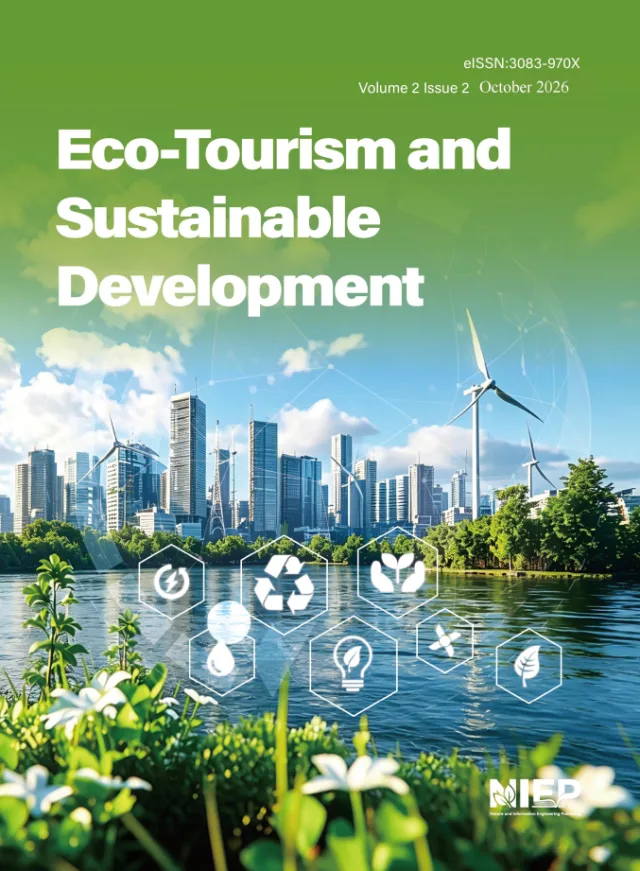
Published in Eco-Tourism and Sustainable Development (ETSD), Vol.2 No.2, 2026
1. Why This Article: From “Conventional Ecotourism” to “Sustainability Under Extreme Conditions”
From its very first issue, Eco-Tourism and Sustainable Development (hereafter ETSD) has defined its own coordinates: rather than churning out yet another conventional ecotourism paper built on “green mountains and clear waters plus tourist growth,” it places tourism development, ecological conservation, community survival, and institutional resilience on the same scholarly map.
The submission scope defined on our journal's website covers destination management for ecotourism, environmental impact assessment, community participation, heritage protection, climate adaptation, and digital technological innovation; yet what matters even more is the stance implied in a single sentence—“sustainability” is not an adjective for a society in steady state, but the capacity to survive that still holds even in the midst of crisis.
The article by Bovsh, Rasulova, and Hopkalo, “Reframing Sustainable Tourism in Crisis-Affected Destinations,” happens to strike precisely at the hardest-core test case for this stance:
The sample is not a mature resort but Ukraine, where physical accessibility has been destroyed, institutions have been damaged, and the narrative of identity has been torn apart;
The method is not a model simulation but semi-structured interviews with 15 experts plus thematic analysis, reconstructing “war—environmental degradation—collapse of tourism trust” into a researchable systemic mechanism;
The conclusion is not “rebuild after peace comes,” but an adaptive model in which strategic communication, community participation, and digital memory run concurrently along three tracks.
It drives home, to the limit, the very question ETSD has long sought to advance: when a destination can hardly even “stay alive,” does “sustainability” in ecotourism still hold? And if it does, on what does it rest? This article is precisely the “stress-test exemplar” that our journal must include in this issue.
2. The Scholarly Tension of the Article Itself: Turning “Soft Mechanisms” into “Hard Conclusions”
1. Environmental degradation is not a single variable but a system destabilizer
Most tourism research treats environmental degradation as a “loss on the resource side”: fewer trees, fouled water, ruined trails. The breakthrough of this paper is that, in a crisis, environmental damage breaches three layers at once: institutional capacity (who can still govern, approve, and rescue), destination identity (the narrative of “I am an ecological paradise” loses its force), and tourist trust (not “is it fun” but “do I dare come”). This turns “ecological restoration” from a technical task for environmental agencies into the master problem of rebuilding the tourism system as a whole.
2. Physical repair ≠ destination revival
The article's most piercing judgment is this: rebuilding roads, erecting hotels, and restoring viewing platforms is merely a “hardware reinstall.” The true bottleneck of tourism recovery is narrative continuity—whether that question in the tourist's mind, “is this place still worth thinking about,” is answered. The authors therefore decompose recovery into a “packaged system”: community-based ecological revitalization (the people are still there), strategic communication (the signals are still there), and digital memory (the stories are still there). This exactly echoes the three-dimensional sustainability—ecological, economic, and sociocultural—that ETSD emphasizes, rather than one-dimensional environmentalism.
3. Digital memory: a wholly new variable in crisis tourism studies
“Digital memory” is not as simple as putting photos online. The article conceptualizes it as:
the process of preserving and reinterpreting a destination through digital means under conditions of physical inaccessibility, so that it maintains its sociocultural vital signs.
This is of enormous significance for our journal—it lifts “technological innovation” from QR-code guide tours and smart scenic areas to the height of critical infrastructure for destination survival, transferable across war and turmoil, climate disasters, pandemic lockdowns, and natural disasters alike.
4. Stakeholders as “communication actors”
The article refuses to treat communities as objects to be rescued. Locals, managers, and practitioners are the frontline nodes in the reproduction of trust. This resonates perfectly with the fact that ETSD's “community participation” field is not decoration but the core of its methodology.
3. Why This Issue Should Feature It: Three Resonances with Our Journal's Positioning
1. Echoing the research gap on “non-steady-state destinations”
Mainstream ecotourism journals favor the European Alps, North American national parks, and mature community tourism in Southeast Asia; crisis zones, conflict zones, the Global South, and post-conflict societies have long been written off as “unsuitable for research” or “only fit for humanitarian reports.” One facet of ETSD's differentiated positioning is precisely its attention to emerging regions, fragile areas, and localized governance experiences overlooked by mainstream venues. The Ukraine case appears, on the surface, European, but is in substance an extreme slice of a “high-fragility destination.” Choosing it is tantamount to a declaration to the academy: we do not only study “how to do tourism well,” but also “how not to let tourism suffocate when it is on the verge of death.”
2. Echoing the triangular balance of “theory—policy—case”
Our journal wants neither theory models alone nor travelogue-style cases. This article possesses, at once, theoretical contribution (an adaptive sustainable-tourism model), policy implications (crisis communication, digital archives, and community empowerment), and case substance (real expert interviews plus a transferable framework). It is a paper that “can enter a literature review and a government after-action deck alike”—exactly the kind of manuscript ETSD seeks to accumulate.
3. Echoing the “public-knowledge responsibility” of open access
As an OA journal, ETSD's readership is not limited to scholars but includes policy agencies, destination managers, NGOs, and community planners. Once the Ukraine experience becomes open access, it can inform destinations from Libya and Palestine to the Caucasus, the earthquake-stricken zones of South Asia, and climate-displaced destinations in the Pacific islands. Publishing it is a proactive intervention in which the journal translates “local suffering” into a “shared methodological library for humanity.”
4. Uniqueness, Innovation, and Singularity: What “Irreplaceable” Value This Article Brings to the Journal
1. Uniqueness: placing “war” in the canon of ecotourism
When ecotourism has addressed conflict in the past, it has mostly meant “post-conflict restoration” or “military-heritage tourism.” This paper is a study of tourism-system restructuring amid ongoing conflict; it does not shy away from the gunfire and does not sentimentalize ecology. This honesty—a refusal to prettify—is part of the scarcity of the ETSD brand.
2. Innovation: proposing “digital memory” as a component of tourism resilience
Existing resilience research mostly speaks of infrastructure resilience or supply-chain resilience. This paper engineers “memory—narrative—trust” and offers an operational chain: image archiving → oral history → online exhibition → sustaining identity → stabilizing investment expectations. This wins “digital humanities of tourism” a legitimate seat within sustainability journals.
3. Singularity: a reusable skeleton for a crisis-adaptive model
What the article yields is not a conclusion exclusive to Ukraine but a set of extractable skeletons: identifying the system's breaking points (ecological / institutional / identity / trust), establishing community communication nodes, launching a digital-twin form of memory, replacing advertising logic with strategic communication, and running physical recovery and narrative recovery in parallel. Whatever special issue takes on post-disaster tourism, climate-induced displacement, or heritage under fire in the future, this article will be a citation anchor. ETSD's early publication, debut, and open access amount to seizing the power to define the terminology.
5. Concrete Contributions to Our Journal's Development
First, it sharpens the edge of our topic selection. It turns ETSD from an “ordinary ground for ecotourism” into “a daring journal that engages extreme conditions,” naturally extending afterward into a series of topic assets—mountain tourism under climate collapse, the digital rebirth of post-earthquake destinations, cultural-tourism self-governance in refugee communities, and the interim governance of natural heritage in conflict zones.
Second, it strengthens the reach of our editorial board and author network. The Ukrainian team, Eastern European crisis studies, digital humanities scholars, and the UNEP/UNWTO citation lineage will draw in a new cohort of authors, moving our journal from an “ecology + tourism” intersection toward a super-intersection of “ecology + security + communication + digital governance.”
Third, it raises the journal's visibility to policy and international institutions. The article speaks directly to UNESCO's protection of cultural property, UNEP's work on the environmental impacts of conflict, and the UNWTO development framework, helping the journal enter the reference layer of policy briefs, international training, and destination-recovery guidelines.
Fourth, it consolidates a publishing character that is “translatable into practice.” ETSD aims to bridge scholars—policy—industry, and this article proves that cutting-edge qualitative research can also be used directly by mayors, protected-area station chiefs, and emergency-response units in culture-and-tourism bureaus.
Fifth, it builds a narrative memory point for the journal. Every new journal needs “the first batch of articles to be remembered,” and this Ukraine piece in Vol.2 No.2 may well become an early signature work of ETSD—mention ETSD, and peers will think of “that journal that was explaining war-torn destinations clearly very early on.”
6. Summary of the Significance of Publication: Not a “Soft-Sell Guide” but a Declaration of the Journal's Stance
We featured this article not because it is trendy, but because it compresses our journal's publishing philosophy to its thinnest and brightest point:
The “ecology” in ecotourism is not only the natural world; the “sustainability” in sustainable is not only the growth curve; the “destination” in destination must, even when it cannot be reached, still be narrated, believed, and waited for.
The value of this article lies in redefining “crisis” from a state of exception to one of the native settings of sustainable tourism. It tells its readers: even without safety, you can start with memory; even without tourists, you can begin to nurture trust; even without an intact ecosystem, you can first preserve the “genius loci”; even before reconstruction is complete, you can first restart the narrative. This is exactly the question ETSD wishes to answer alongside our age.
7. Conclusion: Making the Journal a “Backup Power Supply for Destinations”
Ukraine's trails will be rebuilt, its viewing platforms re-erected, and its guesthouses lit up again. What is harder is ensuring that the world does not delete this land from its heart before the lights come back on. The research by Bovsh and colleagues reminds us that a scholarly journal is not merely a vessel for publishing results; it can be a “backup power supply” for destinations in crisis—using papers to sustain memory, frameworks to hold hope in trust, and open access to keep the door to return open.
Choosing it for this issue is a scholarly judgment and an editorial stance: we record ecology, and we record how ecology refuses to be extinguished amid the gunfire; we study tourism, and we study how tourism is still loved even when it is out of contact. This is another reason for Eco-Tourism and Sustainable Development to exist.
References
[1] Bovsh, L., Rasulova, A., Hopkalo, L. (2026). Reframing Sustainable Tourism in Crisis-Affected Destinations: Strategic Communication, Digital Memory, and Destination Recovery in Ukraine. Eco-Tourism and Sustainable Development, 2(2). https://doi.org/10.63385/etsd.v2i2.101056
[2] United Nations Environment Programme (UNEP). (2025). Environmental Impact of the Escalation of Conflict in the Gaza Strip.
[3] Zoi Environment Network. (2024). The Environmental Consequences of the War against Ukraine: Preliminary Twelve-Month Assessment.
[4] World Tourism Organization (UNWTO). (2018). Tourism for Development—Volume I: Key Areas for Action.
[5] Hall, C.M., Prayag, G., Amore, A. (2018). Tourism and Resilience: Individual, Organisational and Destination Perspectives. Bristol: Channel View Publications.
Journal Information
Title: Eco-Tourism and Sustainable Development
eISSN: 3083-970X (OA, Open Access)
Publisher: Nature and Information Engineering Publishing (NIEP)
Volume/Issue: Volume 02 | Issue 02 | October 2026
Website: https://journals.niepublish.com/etsd
Editorial Team: https://journals.niepublish.com/etsd/about/editorialTeam
Submissions: contact@zycentre.com