 Open Access

News & Announcements
Is the Money from Ecotourism Really Reaching Local People's Pockets?
26 October 2026

— Understanding the Global Exploration of Community-Based Ecotourism
A Featured Reading Guide from “Eco-Tourism and Sustainable Development”
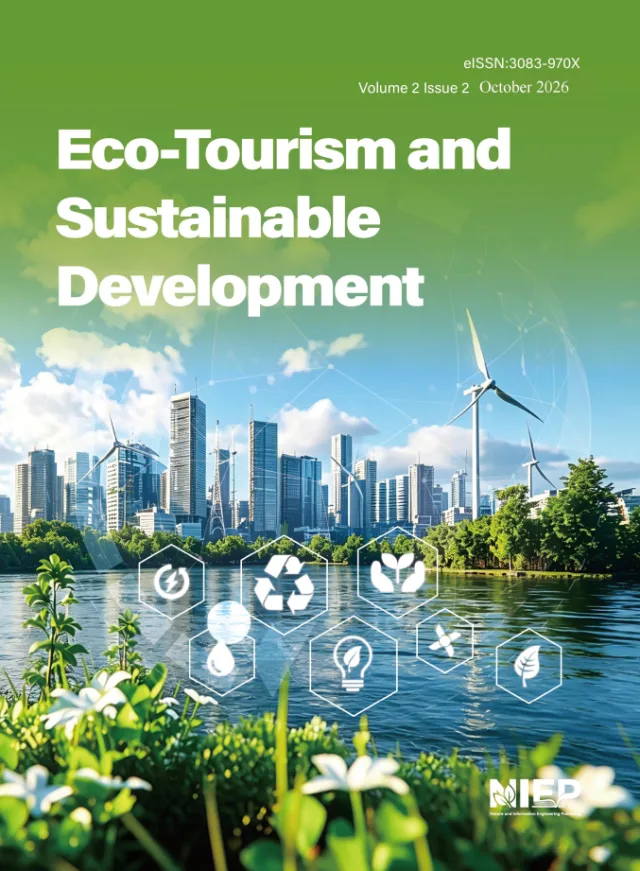
In October 2026, Volume 2, Issue 2 of Eco-Tourism and Sustainable Development was officially published. It is an open-access international academic journal published by the Nature and Information Engineering Publishing in Malaysia, with Professor Lóránt Dénes Dávid of Hungary serving as editor-in-chief and an editorial board that brings together outstanding scholars from around the world. The journal focuses on ecotourism, sustainable destination management, community participation, biodiversity conservation, and the balance of tourism development. This issue's featured reading guide, “Is the Money from Ecotourism Really Reaching Local People's Pockets?”, directly addresses the cutting-edge theme of community-based ecotourism. Drawing on the journal's editorial positioning, this article explains the reasons for the guide's selection, its value, and how it supports the journal.
1. Rationale for Selection: A High Degree of Fit with the Journal's Field
This journal's decision to feature this reading guide rests first on its high degree of fit with our editorial field. The journal positions itself around “community participation” and “the balance of tourism development,” and community-based ecotourism is precisely the core practical locus of this theme: communities are both the “gatekeepers” of ecological conservation and the rightful beneficiaries of tourism dividends. The revenue distribution, co-management, capacity empowerment, and institutional design discussed in the article are exactly the cutting-edge topics to which this journal devotes particular attention—“community tourism governance” and “ecotourism planning.” Second, the article squarely confronts the real-world pain points of global ecotourism revenue leakage and distributional imbalance, combining academic value with practical concern and offering ways forward for destinations worldwide. Third, building on papers published in this journal, the guide assembles a complete logical chain—“why participate—how to participate—where the pain points lie—how to break through—where to go next”—demonstrating the journal's cross-disciplinary integrative capacity.
2. Decoding the Core Content: The Global Exploration of Community-Based Ecotourism
The reading guide unfolds a five-part analysis around the question of “whether ecotourism revenues truly benefit local communities.” First, why ecotourism cannot get around “community”: the three keywords in the definition of ecotourism—“protecting the environment, sustaining local well-being, and educating tourists”—show that it is not merely “sightseeing” but a “partnership” between people and nature. Forests, wetlands, and wild animals largely lie on land where communities have lived for generations; if local people do not find conservation beneficial, no number of prohibitions can stop poaching and logging, whereas communities become the most steadfast “gatekeepers.” The UN World Tourism Organization stresses that community participation is not a “bonus” but a “passing mark,” and several papers in this issue all point to the conclusion that the degree of community participation can almost predict, in advance, the success or failure of an ecotourism project.
Second, community participation in practice broadly shows three levels. The most basic is “sharing revenue”: through ticket revenue sharing, employment, and the direct supply of local products, communities share in the benefits—for example, Volcanoes National Park in Rwanda directs 10% of its mountain-gorilla tourism revenue straight to community development, turning local residents from “poachers” into “guardians.” One level higher is “co-management”: community representatives join the management committee of a protected area and take part in patrols, monitoring, and rule-making. The highest level is “empowerment”: through cooperatives, skills training, and microcredit, communities independently run guesthouses, serve as guides, and build brands—the community forestry and tourism program in Nepal's Annapurna Conservation Area is a model of “co-management plus empowerment.”
Third, the real-world pain point lies in “leakage” and unequal distribution. A considerable share of tourist spending flows back into the pockets of developed countries through channels such as international hotel chains, foreign airlines, and imported goods; in many developing countries the leakage rate of tourism revenue exceeds 40%, so of the ten yuan a tourist spends, often less than six yuan actually stays in the destination. Even more troubling is the unequal distribution: revenues are concentrated in the hands of large capital and outside operators, leaving local communities with only low-paid, casual work, while women, youth, and indigenous people are frequently marginalized. If communities receive only the “scraps left over,” community participation is nothing more than a face-saving gesture.
Fourth, the way forward lies hidden in the four words “institutional design.” First, use laws or concession contracts to clearly define communities' revenue-sharing ratios and introduce third-party audits. Second, establish community co-management committees and community trust funds so that villagers have a genuine voice in revenue distribution. Third, harness the power of certification and standards—for example, Costa Rica's tourism sustainability certification turns “community-friendly” into a quantifiable indicator. Fourth, let technology help, with booking platforms connecting directly to community guesthouses and revenues made transparent in real time. Research also cautions that community participation should begin at the project-planning stage.
Fifth, the keywords for the next stage are “capacity” and “resilience.” On the one hand, the move must be from “sharing the cake” to “making the cake”: through training and entrepreneurship support, communities gain the capacity for independent operation, so that young people are willing to stay in rural areas. On the other hand, shocks such as climate change and pandemics remind us that communities overly dependent on tourism are extremely vulnerable and need diversified income sources and risk-sharing mechanisms. As travelers, choosing destinations and operators backed by community participation makes every trip a “vote” cast for local people.
3. Value and Significance of Publication: An Examination from Four Perspectives
The value of publishing this reading guide can be examined on four levels—discipline, practice, readership, and international discourse. On the disciplinary level, the guide develops “community participation” into a three-tier progressive model of “revenue sharing—co-management—empowerment,” injecting the capacity-building idea of “from sharing the cake to making the cake” and moving community-participation research from slogan toward institutionalization, thereby echoing the journal's academic directions of “community tourism governance” and “ecotourism planning.” On the practical level, the Rwanda, Nepal, and Costa Rica cases integrated in the guide offer governance references for destination managers worldwide, strengthening the journal's bridging value of “connecting academia and industry.” On the readership level, the guide narrates professional issues in accessible prose, catering to readers at all levels and helping to broaden the readership. On the level of international discourse, the guide's cross-regional, cross-system integration of global cases suits the journal's internationalization positioning, enhancing its international visibility and voice.
4. Uniqueness · Innovation · Exclusivity: How the Guide Boosts the Journal's Development
Analyzed through the lens of the “three qualities,” this reading guide offers notable support for the journal's development.
In terms of uniqueness, the guide cuts in through “community”—the most easily overlooked yet most inescapable foundational link in ecotourism—focusing on the governance dilemma of “whether revenues truly reach local people's pockets” and advancing layer by layer to form a distinct thematic identity. It turns the lens onto marginalized local communities, lending the journal's content a distinctive character of confronting reality and caring for people's livelihood, and shaping this journal's editorial personality of “grounded in ecology, attentive to communities, and oriented to the world.”
In terms of innovation, the guide creatively proposes the three-tier progressive model of “revenue sharing—co-management—empowerment” together with the capacity-building path “from sharing the cake to making the cake,” integrating revenue distribution, governance empowerment, certification constraints, and digital tools into a single way-forward loop and displaying a systematic approach to governance. This integrated framework of “one dilemma, multiple breakthroughs” is highly consistent with the journal's editorial stance on the “cross-disciplinary frontier,” highlighting its forward-looking position in knowledge innovation.
In terms of exclusivity, the guide, through its globally integrative perspective on cases from Rwanda, Nepal, Costa Rica, and elsewhere, places the community-participation experiences of different cultural and institutional backgrounds within a single analytical framework. This holds scarce value among comparable journals and builds a comparative platform for dialogue among researchers worldwide, suiting this journal's international positioning of open access, a global editorial board, and stable semiannual publication. Such exclusivity translates into a content moat and brand distinctiveness for the journal—when readers think of “global community-based ecotourism,” they naturally associate it with this journal, reinforcing its leading position in this niche and helping it occupy a unique ecological niche.
5. Conclusion: Letting Communities Benefit and Sustainability Take Root
“The original intention of ecotourism has never been to turn nature into a ticket-based tourist economy, but to give conservation its rewards, communities their prospects, and tourists their gains.” This closing line runs exactly in step with the journal's editorial philosophy: the sustainable development of ecotourism is not about concentrating revenues in the hands of capital and outside operators, but about letting the benefits of ecological conservation truly flow back to communities and returning decision-making power truly to communities, achieving a plural balance among ecology, economy, and society and culture. This journal's decision to feature the guide is both a proactive response, grounded in its editorial field, to real-world dilemmas and a long-term strategy to coalesce a community through high-quality content and expand its international influence. In the future, the journal will continue to stand at the frontier of ecotourism and sustainable destination management, publishing research that combines scholarly rigor with concern for reality, so that “global exploration” takes root and grows ever deeper.
References
1. The International Ecotourism Society (TIES). (2015). What Is Ecotourism?
2. United Nations World Tourism Organization (UNWTO). (2023). Sustainable Tourism for Development.
3. Rwanda Development Board (RDB). (2024). Gorilla Tourism Revenue Sharing Programme Report.
4. Nepal Trust for Nature Conservation (NTNC). (2023). Annapurna Conservation Area Project (ACAP) Annual Report.
5. United Nations Environment Programme (UNEP). (2022). Tourism and Local Economic Development: Addressing Leakage.