


About the Journal

Journal of Emerging Markets and Management (JEMM) is a peer-reviewed, open-access journal dedicated to advancing research on business, finance, and management in emerging markets.  JEMM aims to bridge academia and industry, providing insights into economic development, corporate strategies, and policy challenges in developing economies. View full aims and scope

  • Frequency — 3 issues per year (February, June, October)
  • Open Access — freely available to readers worldwide.

News & Announcements

View all →

Journal of Emerging Markets and Management →

Emerging Markets and Management Volume 02  |  Issue 03  |  October 2026   From "World Factory" to "Innovation Engine":How Do Local Firms in Emerging Markets Stage Their Comeback?— A Featured Reading G

Research Articles

View all →

Digitisation as a Socio-Economic Equaliser: Self-Employment, Inclusion, and the Digital Transformation of Kerala’s Economy

Sofia Ahmed Sait, Lekha Kasmir

Journal of Emerging Markets and Management · 1–14 · 10.63385/jemm.v2i3.101045

The research paper discusses the role of digitisation as an enabler of self-employment and socio-economic inclusion in the state of Kerala, which is economically and socio-culturally stratified. In particular, it examines how digitisation is a structural equaliser by altering access to entrepreneurship along gender, caste, and r

Read article →↓ PDF Cite827 views579 downloads

Public Debt, Fiscal Policy and Economic Growth in Nigeria

Hezekiah Amamizo Ogunnubi

Journal of Emerging Markets and Management · 15–24 · 10.63385/jemm.v2i3.101122

This paper examined the impact of public debt and fiscal policy on Nigeria’s economic growth using the Autoregressive Distributed Lag (ARDL) model. The annual time-series data from 1981 to 2023 were obtained from the Central Bank of Nigeria Statistical Bulletin and the World Bank archives. The study analyzed the long-run and sho

Read article →↓ PDF Cite514 views286 downloads

Patterns of Employment and Their Spatial Constraints: Resilience to Climate and Market Crises in Nigeria

Henry Mooney

Journal of Emerging Markets and Management · 25–39 · 10.63385/jemm.v2i3.101164

This research examines the sectoral structure of employment in Nigeria and the way that structure shapes spatial constraints on the economy’s resilience to climate and market crises. Rather than treating social capital as a measured variable, the study frames it as contextual background and instead analyses observable sectoral e

Read article →↓ PDF Cite391 views240 downloads

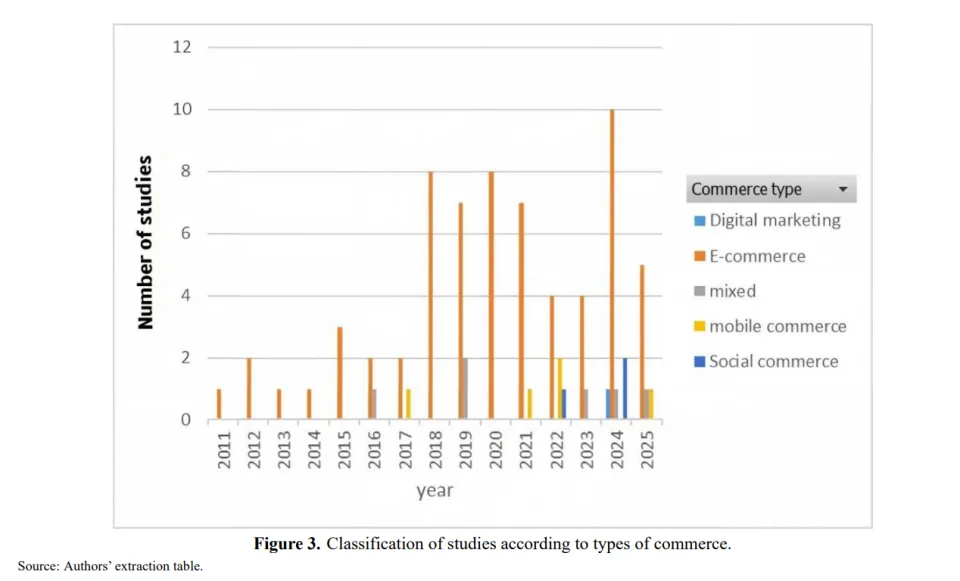
Digital Commerce Adoption in Ghana: A Scoping Review of Trends, Drivers, Barriers, and Enablers

Vanessa Enyonam Amenyawu, Vivian Amoako Osafo, Nathan Awelama Atigah, Naa Adjeley Sackey

Journal of Emerging Markets and Management · 40–64 · 10.63385/jemm.v2i3.101095

The digital economy in Ghana has grown exponentially over the last decade, driven by rising rates of mobile and internet penetration, the growth of fintech and mobile money services, the unexpected pandemic, and the integration of social media into the Ghanaian economic landscape. Nevertheless, scientific evidence that synthesis

Read article →↓ PDF Cite834 views482 downloads

Foreign Capital Inflows and Financial Development: The Moderating Effects of the Governance Climate and Human Capital across the MEDA Region

Francesco Scalamonti

Journal of Emerging Markets and Management · 65–83 · 10.63385/jemm.v2i3.101039

In the globalized world, there is a closed relationship between foreign capital inflows (CI) and financial development (FD) of a country. Therefore, this study aims to investigate the relationship between FD and CI across the Southern and Eastern Mediterranean countries (MEDA region), covering the period 2000–2019, since MEDA tr

Read article →↓ PDF Cite768 views607 downloads

Awareness of Porter’s Five Forces Framework: A Research Paper

Ioannis Petrou Hadjipetrou

Journal of Emerging Markets and Management · 84–95 · 10.63385/jemm.v2i3.100695

In 1980, a young economist called Micheal E. Porter made a revolution in the field of Industrial Organization by publishing his article on the attractiveness of industries and the five forces that influence them. Although the model still has some validity, it has heavily been criticized as obsolete since the introduction of inte

Read article →↓ PDF Cite1,371 views743 downloads

An Assessment on Service Quality in the Ethiopian Insurance Industry: A PLS-SEM Analysis

Mubarek Sadik Hussen, Abdo Dabaso Jaldesa, Garbicha Duba Wako

Journal of Emerging Markets and Management · 96–113 · 10.63385/jemm.v2i3.101059

This study presents a rigorous quantitative investigation of the determinants of customer satisfaction in the Ethiopian insurance sector, grounded in the Service Quality (SERVQUAL) model. The research analyzes empirical data using Partial Least Squares Structural Equation Modeling (PLS-SEM) to evaluate information gathered from

Read article →↓ PDF Cite755 views344 downloads

The Fiduciary Digital Encounter: Developing a Grounded Theory of Institutional Trust Work and Service Quality in Nigeria's SME Banking Ecosystem

Ekejiuba Augustine Nnaemeka

Journal of Emerging Markets and Management · 114–131 · 10.63385/jemm.v2i3.102684

This study develops a grounded theory of digital banking service quality by examining how Small and Medium-sized Enterprises (SMEs) in Nigeria evaluate digital banking services under conditions of institutional uncertainty. Using a Straussian grounded theory approach, data were collected through 54 in-depth episodic narrative in

Read article →↓ PDF Cite222 views163 downloads
Browse all articles →

Explore research in this journal

Explore keywords from this journal’s published articles.

Latest Issues

All issues →

OPEN FOR SUBMISSIONS

Your next paper belongs in the conversation.

Review the journal scope and manuscript requirements before submitting your research.

Prepare Your Manuscript
Journal of Emerging Markets and Management cover